
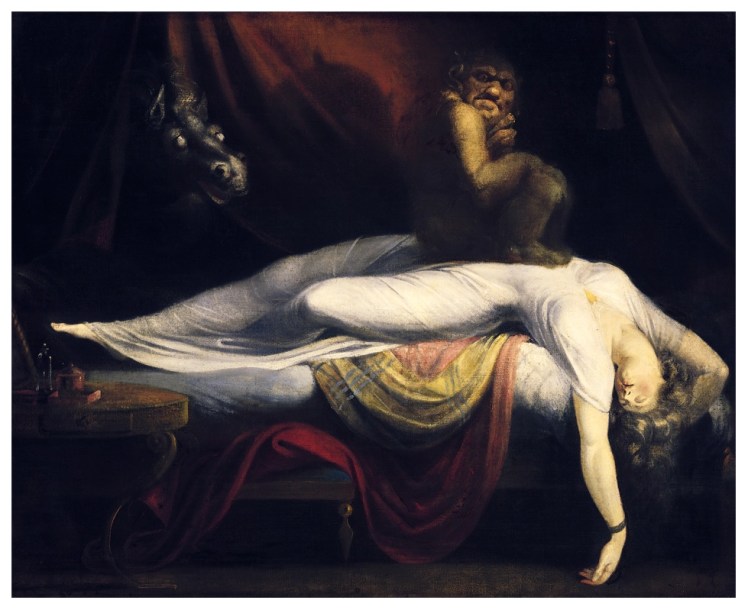
Henry Fuseli (1781) “The Nightmare”
In my last post, we discussed some tips on how to write good horror. To continue, I thought it best to learn from one of the most renowned authors of horror, Edgar Allen Poe. Specifically, we will be discussing a couple of his techniques used in, “The Fall of the House of Usher” that make it a successful work of horror fiction. Together, we can analyze how he does what he does so well.
Brief (spoiler-free) Summary:
“The Fall of the House of Usher” follows an unnamed narrator as he arrives at the House of Usher at the request of a childhood friend. This friend, Roderick Usher, suffers from a nervous disorder resulting in painfully heightened senses, and requires the narrator’s presence for comfort. The story recounts the narrator’s experiences within the house as he witnesses his friend’s mental decline.
Analysis
One of Edgar Allen Poe’s greatest strengths is his use of descriptive and poetic language to immerse the reader into the story’s setting. In the beginning of this piece, Poe spends a significant amount of time describing the house, the land it sits on, and even the bleak weather. He uses descriptive phrases, such as “soundless day” and “the clouds hung oppressively low in the heavens” to create a depressing and gothic atmosphere. In the same passage, Poe states, “There was an iciness, a sinking, a sickening of the heart-an unredeemed dreariness of thought”. His use of the senses creates a feeling of being weighed down or trapped by some invisible force or emotion. All of which helps the audience feel the tension and uneasiness of the story more deeply.
Another of Poe’s techniques that solidify him as a horror classic is his ability to create suspense. He does this in many ways, but most notably in how he utilizes ambiguity, connecting to human’s innate fear of the unknown. In “The Fall of the House of Usher”, there is a lot that the narrator, and therefore the readers, do not know. We are unaware of whether Roderick and Lady Madeline’s illnesses are purely medical or supernatural. Upon approaching the estate, the narrator immediately feels an unexplainable sense of dread. There is no tangible reason for this fear (yet), however it is a feeling that he can’t shake, and which makes him question his sanity. He is left wondering whether the appearance of the estate is playing tricks on his mind, or whether his friend’s madness is affecting him. This not knowing only deepens his feelings of unease, and therefore deepens ours. It plays on that instinctual, gut feeling that something is wrong, but with no way to make sense of it. Which is perhaps scarier than knowing. The skill here is knowing what to reveal to readers and when. Poe gives enough information to be unnerved, but not enough to give it away.
If you’d like to read “The Fall of the House of Usher”, you can read it here. It was also recently made into a T.V show on Netflix directed by Mike Flannigan (one of my personal favorite directors)
 Life Without Limits